

Government teacher salary in India is one of the most controversial topics today. Many people now suggest an extreme solution: cut 80% of teacher salaries and link the rest to performance. It sounds strict and effective, but in reality, it can damage the education system instead of fixing it.
Government Teacher Salary in India: The Real Debate
Government teachers in India often earn more than private school teachers, along with job security and benefits. This creates a perception of high pay and low accountability. However, the core issue is not salary but system design and lack of performance tracking.
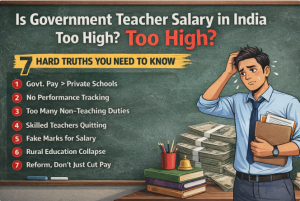
Why People Suggest 80% Salary Cut for Teachers
The idea comes from frustration:
– Poor classroom teaching in many schools
– Heavy dependence on coaching institutes
– Weak accountability systems
People assume that cutting salary will force teachers to perform better.
What Happens If Government Teacher Salary in India Is Cut by 80%
This approach creates serious risks:
– Skilled teachers leave for private sector or coaching
– New talent avoids government teaching jobs
– Teachers manipulate marks to secure income
– Weak students are ignored
– Rural education systems collapse
Instead of improvement, the system becomes unstable.
The Hidden Risk: Why Good Teachers Will Leave First
Not all teachers will leave, but the best ones will. Skilled teachers have better options and will move out quickly. This creates a system where weaker performers remain, reducing overall education quality.
Problems in the Current Education System
The real issues are structural:
– No proper performance measurement
– Promotions not linked to teaching quality
– Non-teaching duties like elections and surveys
– Lack of modern tools and training
Even capable teachers struggle under these conditions.
Why Performance-Based Salary Alone Fails
If salary depends only on marks:
– Teachers inflate scores
– Easy exams become common
– Real learning decreases
– Weak students get ignored
This creates fake performance instead of real improvement.
How to Measure Student Performance the Right Way
The correct approach is student growth tracking:
– Baseline test at the start
– Endline test after a period
– Measure improvement, not raw marks
This ensures fair evaluation across different student backgrounds.
What to Do with Low-Performing Teachers
Instead of instant punishment, use a structured system:
1. Identify weak areas using data
2. Provide training and mentoring
3. Set improvement targets
4. Re-evaluate performance
If performance does not improve:
– Warning and monitoring
– Salary increment freeze
– Transfer or role change
– Final removal if required
This ensures accountability without system damage.
The Right Reform Model for Government Teacher Salary in India
A balanced approach works best:
– 75–80% fixed salary for stability
– 20–25% performance-based incentives
Performance should include:
– Student improvement (not just marks)
– Attendance and engagement
– Classroom observation
– Feedback from students and parents
This reduces manipulation and improves real learning.
Role of AI in Improving Teacher Performance
AI can strengthen the system:
– Automated answer checking
– Performance analytics
– Identifying weak students
– Tracking progress over time
However, AI cannot replace teachers. Human interaction remains essential.
Conclusion
Government teacher salary in India is not the real problem. Cutting salaries by 80% is an extreme and risky solution that can weaken the system. The real solution is better measurement, accountability, and balanced incentives. Fix the system, and performance will improve naturally.
