

# Content
Caste based discrimination in India is officially illegal, yet it continues to exist in everyday life. The contradiction is simple: the law has changed, but society has not.
What Is Caste Based Discrimination in India?
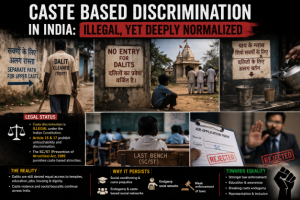
Caste discrimination refers to unequal treatment of individuals based on their caste. This can include social exclusion, denial of opportunities, humiliation, and even violence.
Is Caste Discrimination Still a Reality Today?
Yes. It may not always be visible, but it exists in multiple forms:
– Hiring bias in jobs
– Social segregation in villages
– Marriage restrictions
– Discrimination in schools and public spaces
The system has evolved, but it has not disappeared.
Why Caste Based Discrimination in India Still Exists
The biggest reason is mindset.
– People inherit caste identity from birth
– Families reinforce it through upbringing
– Society rewards conformity and punishes deviation
This creates a self-sustaining system where discrimination becomes normalized.
The Role of Society and Social Conditioning
Caste is not just a system — it is a social habit.
From childhood, people are taught:
– Who to associate with
– Who to avoid
– What is “acceptable”
Over time, this conditioning becomes invisible, making discrimination seem natural instead of wrong.
What the Law Says About Caste Discrimination
:contentReference[oaicite:0]{index=0} clearly prohibits caste-based discrimination.
– Equality before law is guaranteed
– Untouchability is abolished
– Discrimination is punishable
Additionally, strict laws exist to protect marginalized communities.
Why Laws Alone Are Not Enough
Despite strong legal frameworks, caste discrimination continues because:
– Many cases go unreported
– Victims fear social backlash
– Local systems often fail to act
– Social pressure overrides legal awareness
Law can punish actions, but it cannot instantly change beliefs.
What Needs to Change
Real change requires more than laws:
– Social mindset must evolve
– Inter-caste interactions should increase
– Education must challenge outdated beliefs
– Individuals must question inherited biases
Without these changes, the system will keep adapting and surviving.
Conclusion
Caste based discrimination in India is not just a legal issue — it is a social reality. Until people stop accepting it in daily life, no law will fully eliminate it. The problem is not lack of rules, but lack of change in thinking.
